

Why Do I Feel Off During Certain Moon Phases? What Vedic Astrology Actually Says
Written by Aashish Kashyap · AstroChat Live Astrology Team · Published
Quick answer
Short answer: yes, Vedic astrology has a real explanation for this, and it is not about the moon in the sky, it is about your own moon sign specifically. When the moon transits close to your natal moon sign, many people report feeling more emotional or reactive, and this has a name, sometimes called your monthly moon return.
Why the moon gets blamed for how you feel
You are not imagining this, and you are not the only one who has noticed it. The moon moves through the entire zodiac in about 27 to 28 days, spending roughly two and a half days in each sign. Since the moon governs the mind in Vedic astrology, not just tides, its position is treated as a genuinely moving weather system for your emotional state, not a fixed trait like your sun sign.
What Vedic astrology actually links to your moods
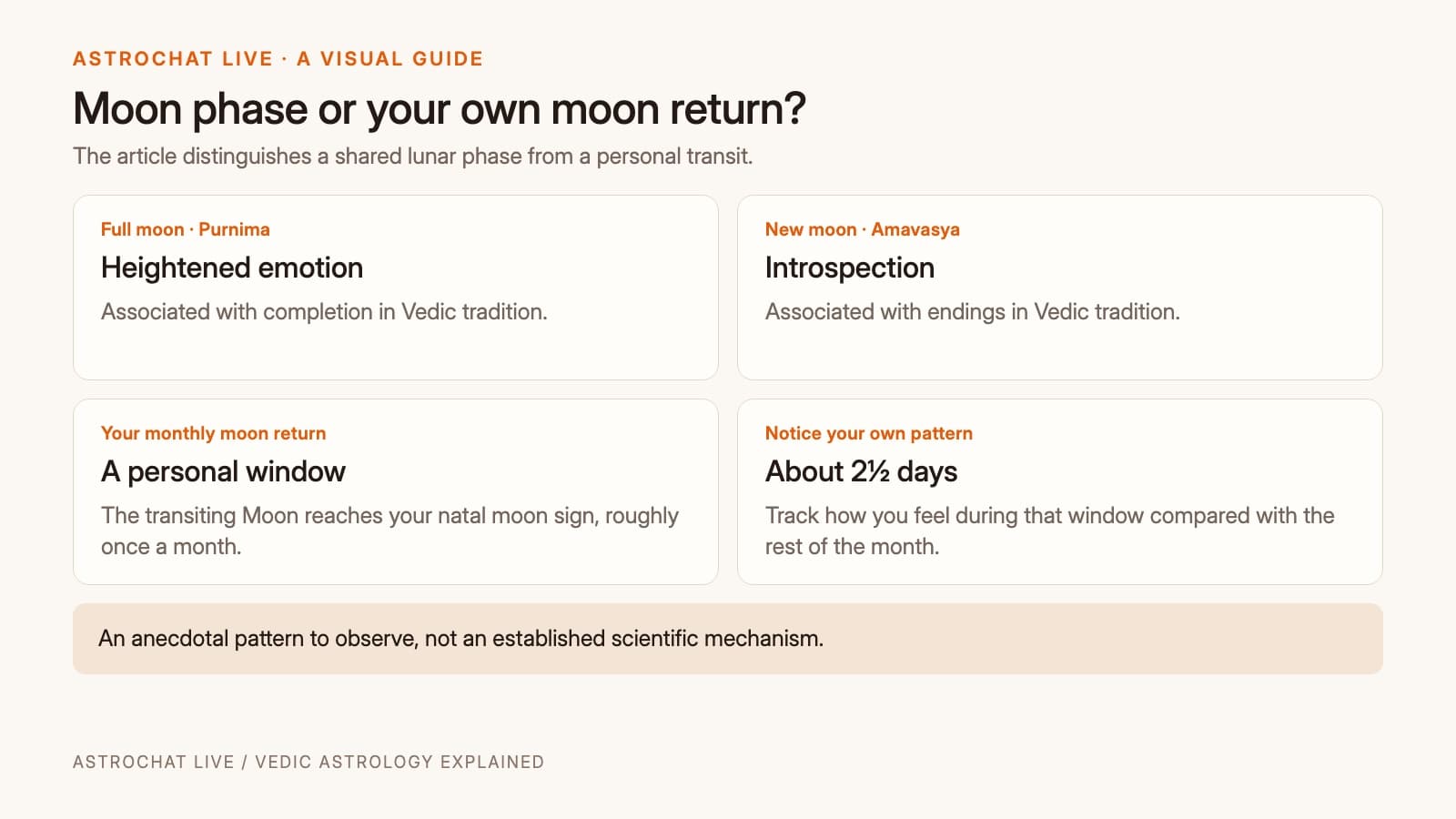
The specific thing to watch is not the phase everyone talks about online, it is where the moon currently sits relative to your own birth moon sign. When the transiting moon lands in your own moon sign, roughly once a month for about two and a half days, this is informally called your monthly moon return, and it is genuinely common to feel more sensitive or easily overwhelmed during that short window.
Full moon vs new moon, do they affect people differently
Western pop culture puts almost all the weight on the full moon, but Vedic tradition treats amavasya, the new moon, and purnima, the full moon, as two different kinds of intensity rather than one being good and one bad. Full moon is associated with heightened emotion and completion, new moon with introspection and endings. That specific off feeling is more tied to your personal moon return than to the phase everyone else is experiencing at the same time.
Is this just superstition, or is there something to it
This is a fair question and deserves a real answer. There is no accepted scientific mechanism connecting the moon's position to mood the way there is for light affecting sleep. What Vedic astrology offers is not a physics explanation, it is a pattern language, a way of naming something a lot of people already notice anecdotally. Tracking it for a couple of months is a low cost way to find out if it holds true for you specifically.
What you can actually do with this information
If you know your moon sign, you can check when the transiting moon will sit in or oppose it, and simply notice how you feel during that window compared to the rest of the month. Some people use this practically, avoiding scheduling emotionally heavy conversations during their own moon return, and saving those for when the moon is elsewhere in the sky.
FAQ
Reading about it is the easy half
Get answers from your own birth details on WhatsApp, or start with today's free rashifal for your sign.