Vedic vs Western Astrology: Why Your Zodiac Sign Might Be Different in Each
Written by Aashish Kashyap · AstroChat Live Astrology Team · Published 16 September 2026
Why the same person gets two different signs
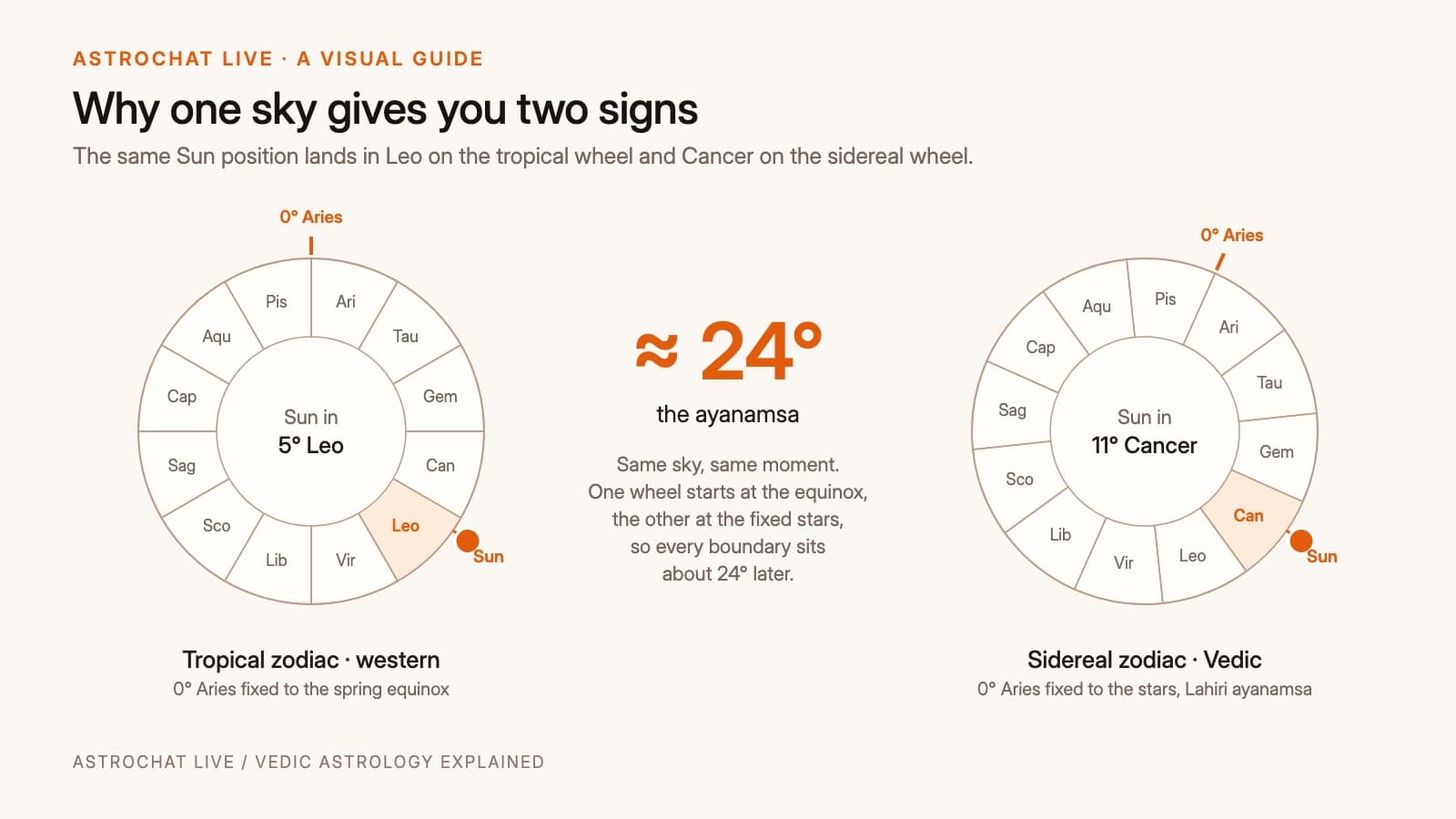
It is one of the most common confusions in astrology. Someone reads that they are a Leo their whole life, then checks a Vedic chart and finds they are a Cancer. Nothing is wrong with either reading. The two systems measure the zodiac from different starting points, and that single difference explains almost all of the confusion.
Sidereal vs tropical, the core difference
Western astrology uses the tropical zodiac, anchored to the seasons, with zero degrees Aries fixed to the spring equinox. Vedic astrology uses the sidereal zodiac, anchored to the actual positions of the fixed stars. Because of the slow wobble of Earth's axis, these two reference points have drifted apart over millennia, currently by roughly 24 degrees, which is enough to shift many people back one full sign.
What ayanamsa means
Ayanamsa is simply the term for that measured gap between the two zodiacs. Different schools use slightly different ayanamsa values, with Lahiri being the most widely used in India and the one adopted officially for Indian calendars. This is why two Vedic charts can occasionally differ slightly if calculated using different ayanamsa settings.
How each system reads a chart differently
Beyond the zodiac offset, the systems diverge in method. Western astrology places heavy emphasis on the sun sign, uses aspects between planets extensively, and includes the outer planets Uranus, Neptune and Pluto. Vedic astrology centres the moon sign, uses the nakshatras, works with divisional charts like the navamsa, and traditionally uses only the seven visible planets plus Rahu and Ketu.
Dasha, the system western astrology does not have
The single biggest practical difference is timing. Vedic astrology has the Vimshottari dasha system, a structured planetary timeline mapping out which periods of life are governed by which planet. Western astrology has transits and progressions but nothing structurally equivalent, which is a large part of why Vedic astrology is often preferred for predictive, when will this happen style questions.
Which system is more accurate
This question has no honest, settled answer, and anyone claiming otherwise is arguing a preference rather than a fact. Both systems have long track records and committed practitioners. What can be said fairly is that they answer different questions well, and that comparing a Vedic prediction to a western one directly is a category error rather than a fair test.
Which one to use for which question
Vedic astrology tends to suit questions about timing, marriage matching, career periods and remedies, and it is the system almost all Indian astrological practice is built on. Western astrology tends to suit psychological and personality focused exploration. Many people use both, reading their western chart for self understanding and their Vedic chart for timing and practical decisions.
FAQ
Reading about it is the easy half
Get answers from your own birth details on WhatsApp, or start with today's free rashifal for your sign.