Vastu Shastra for Your Home: The Principles That Actually Matter
Written by Aashish Kashyap · AstroChat Live Astrology Team · Published 16 September 2026
What Vastu Shastra actually is
Vastu Shastra is a traditional Indian system of architecture and spatial arrangement, built around the idea that the direction and layout of a living space affects the wellbeing of the people inside it. Stripped of mysticism, a lot of it maps onto sensible environmental reasoning about light, airflow and heat in the Indian climate, which is part of why so many of its principles have survived so long.
The five elements and the eight directions
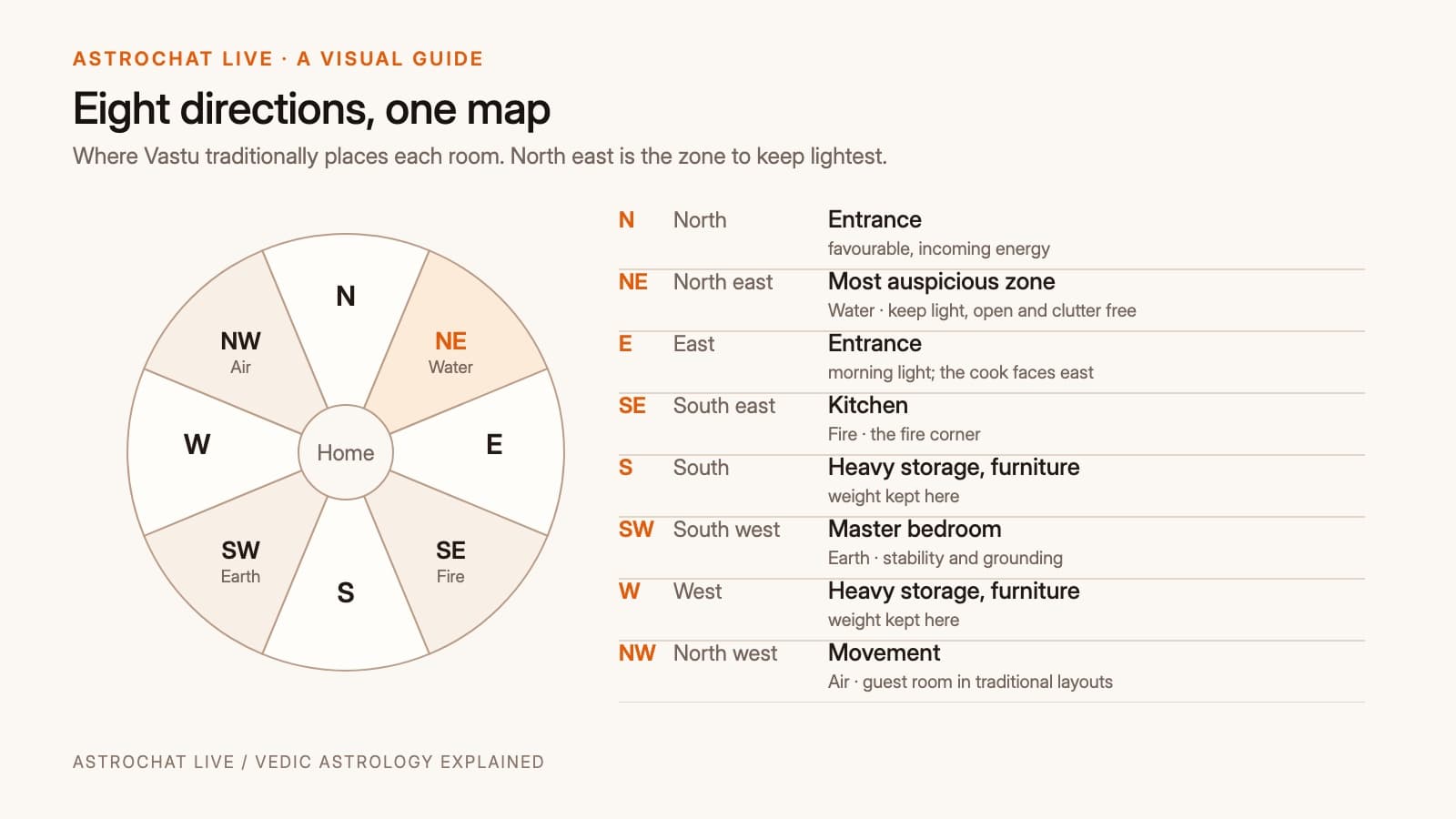
Vastu organises space around the five elements, earth, water, fire, air and space, and assigns each of the eight directions a governing planet and element. North east is associated with water and considered the most auspicious zone, south east with fire, south west with earth and stability, and north west with air and movement. Nearly every specific Vastu recommendation traces back to this mapping.
Entrance, the single most emphasised element
The main entrance receives more attention in Vastu than any other feature, traditionally favoured facing north, east or north east, since these directions are associated with incoming positive energy and, practically speaking, favourable morning light. Where the entrance cannot be moved, traditional practice focuses on keeping it well lit, uncluttered and welcoming rather than treating the direction as an unfixable problem.
Kitchen, bedroom and bathroom placement
The kitchen is traditionally placed in the south east, the fire corner, with the cook ideally facing east while cooking. The master bedroom is favoured in the south west, associated with stability and grounding. Bathrooms are generally kept away from the north east zone. Heavy storage and furniture are traditionally weighted toward the south and west, keeping the north east lighter and more open.
What to do when your flat cannot be changed
This is the most practical question for anyone living in a modern apartment, where moving a kitchen or entrance is simply not an option. Traditional practice offers a realistic answer, focusing on what can be adjusted: mirror placement, keeping the north east corner clutter free, choosing lighter colours in specific zones, and rearranging furniture weight. Vastu compliance is treated as a spectrum, not a pass or fail test.
Vastu and astrology, how they relate
Vastu and Vedic astrology share the same planetary and elemental framework, which is why they are often consulted together, particularly around griha pravesh, house warming. Some astrologers will also weigh a person's own chart when recommending Vastu adjustments, since the planets that need strengthening in a chart connect to the directions associated with them.
Separating principle from superstition
Vastu has attracted a considerable amount of commercial exaggeration, with expensive products marketed as essential corrections for problems that a furniture rearrangement would address. The core principles are about light, airflow, orientation and clutter, all of which are free to act on. Be cautious of any recommendation whose main outcome is an expensive purchase.
FAQ
Reading about it is the easy half
Get answers from your own birth details on WhatsApp, or start with today's free rashifal for your sign.