Planet Retrograde Explained: What Mercury and Saturn Retrograde Actually Mean in Vedic Astrology
Written by Kunal Upadhyay · AstroChat Live Astrology Team · Published 7 September 2026
What retrograde actually means, astronomically and astrologically
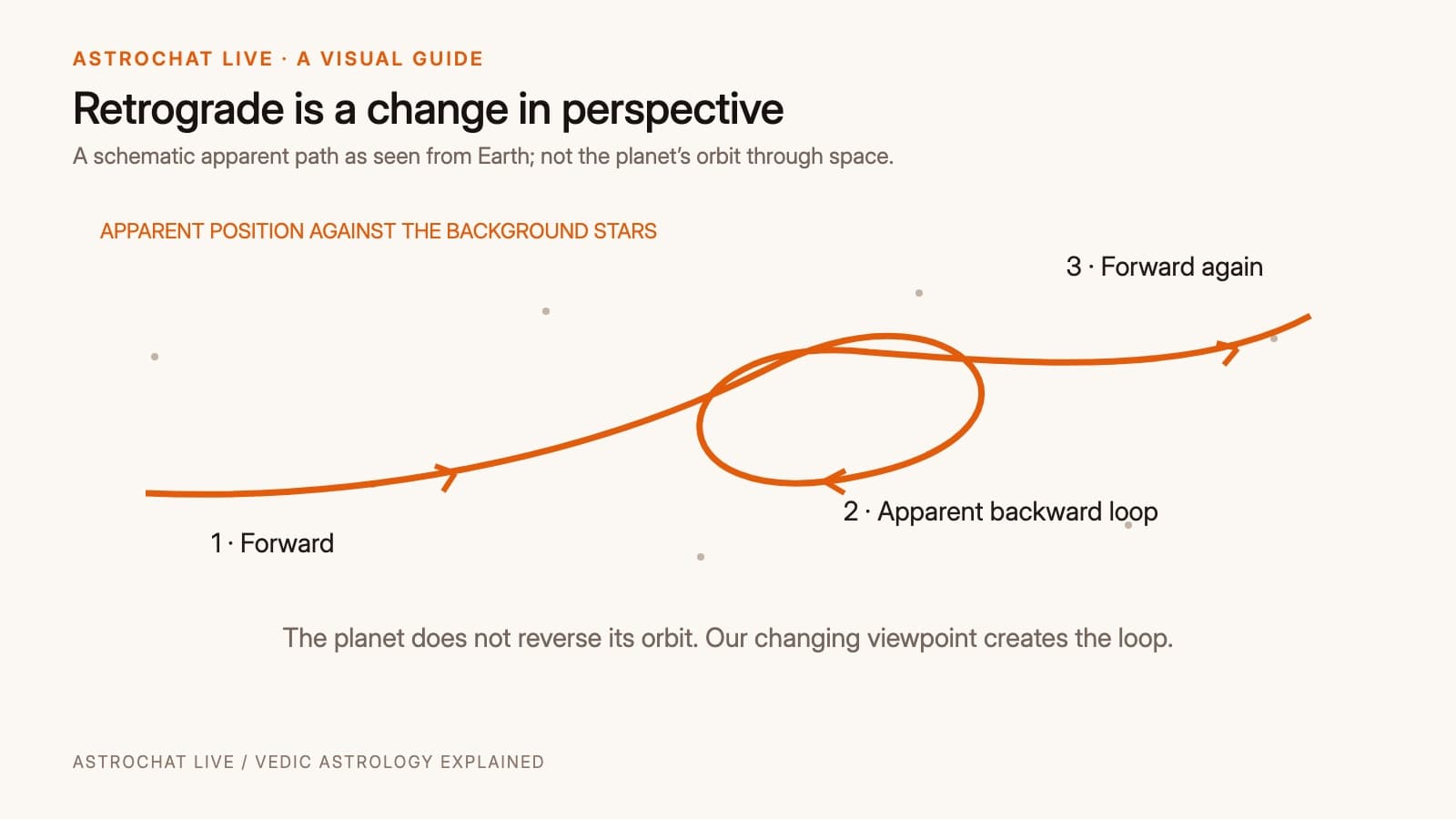
Retrograde refers to the apparent backward motion of a planet as seen from Earth, an optical effect caused by the relative speeds of orbits rather than the planet actually reversing direction in space. Astrologically, this apparent slowdown and reversal is traditionally read as a period where that planet's usual, forward moving energy turns inward, becoming a time for review, reflection and revisiting rather than fresh starts.
Why Mercury retrograde gets blamed for so much
Mercury retrograde has become the most talked about astrological event outside of dedicated astrology circles, largely because it happens several times a year and Mercury governs communication, travel and technology, three things that go wrong often enough on their own that any mishap during this window gets blamed on the planet. This does not mean the effect is imaginary, only that it gets referenced far more casually than most other astrological concepts.
What Vedic astrology actually says about retrograde planets
Interestingly, classical Vedic astrology takes a more nuanced view than popular culture does. A retrograde planet, called vakri in Sanskrit, is sometimes considered to gain unusual strength precisely because of its unusual motion, not automatically weakened as western pop astrology often implies. Whether a retrograde is read as challenging or strengthening depends heavily on which planet it is and where it sits in the individual chart.
Retrograde planets in your own birth chart vs transit retrogrades
There is an important difference between a planet that is retrograde in your birth chart itself, a fixed, permanent placement, and a planet that goes retrograde temporarily during a transit, affecting everyone for a few weeks at a time. A retrograde planet in your own birth chart is a lifelong character trait requiring individual interpretation, while a transiting retrograde is a shared, temporary weather pattern affecting the whole zodiac at once.
Which retrogrades matter more in Vedic practice
While Mercury retrograde dominates popular conversation, Vedic astrologers often pay closer attention to Saturn and Jupiter retrogrades for serious predictive work, since these slower planets govern longer term life themes, and their retrograde periods are read as extended windows for restructuring plans rather than the shorter, communication focused disruptions associated with Mercury.
How to handle a retrograde period without the panic
The most practical approach to any retrograde period, Mercury or otherwise, is to treat it as a genuinely good window for review, revision and finishing existing commitments rather than launching brand new ones, which lines up with the traditional reading of retrograde energy turning inward rather than forward. Avoiding every important decision during a retrograde is generally excessive, being a little more careful and double checking details is usually enough.
FAQ
Reading about it is the easy half
Get answers from your own birth details on WhatsApp, or start with today's free rashifal for your sign.