Health in Vedic Astrology: What the Sixth House Indicates and What It Doesn't
Written by Kunal Upadhyay · AstroChat Live Astrology Team · Published 16 September 2026
An important note before anything else
Vedic astrology has a long tradition of discussing health, but it is essential to be clear at the outset that a birth chart is not a diagnostic tool and should never be used in place of medical care. Anything in this article is offered as traditional context, not as guidance for any health decision. If you have a health concern, see a doctor first, always.
Which parts of a chart relate to health
Traditional health reading draws mainly on the ascendant and its lord for overall vitality, the sixth house for illness and recovery, the eighth house for chronic conditions and longevity, and the twelfth for hospitalisation and rest. As with wealth, no single house carries the reading alone, the relationship between them is what a trained astrologer actually examines.
The ascendant and overall vitality
The ascendant, or lagna, represents the physical body itself, and its ruling planet's condition is traditionally read as an indicator of general constitution and resilience. A well placed ascendant lord is associated with a robust baseline, while an afflicted one is traditionally read as suggesting a need for more deliberate care, which is a tendency rather than a prediction of illness.
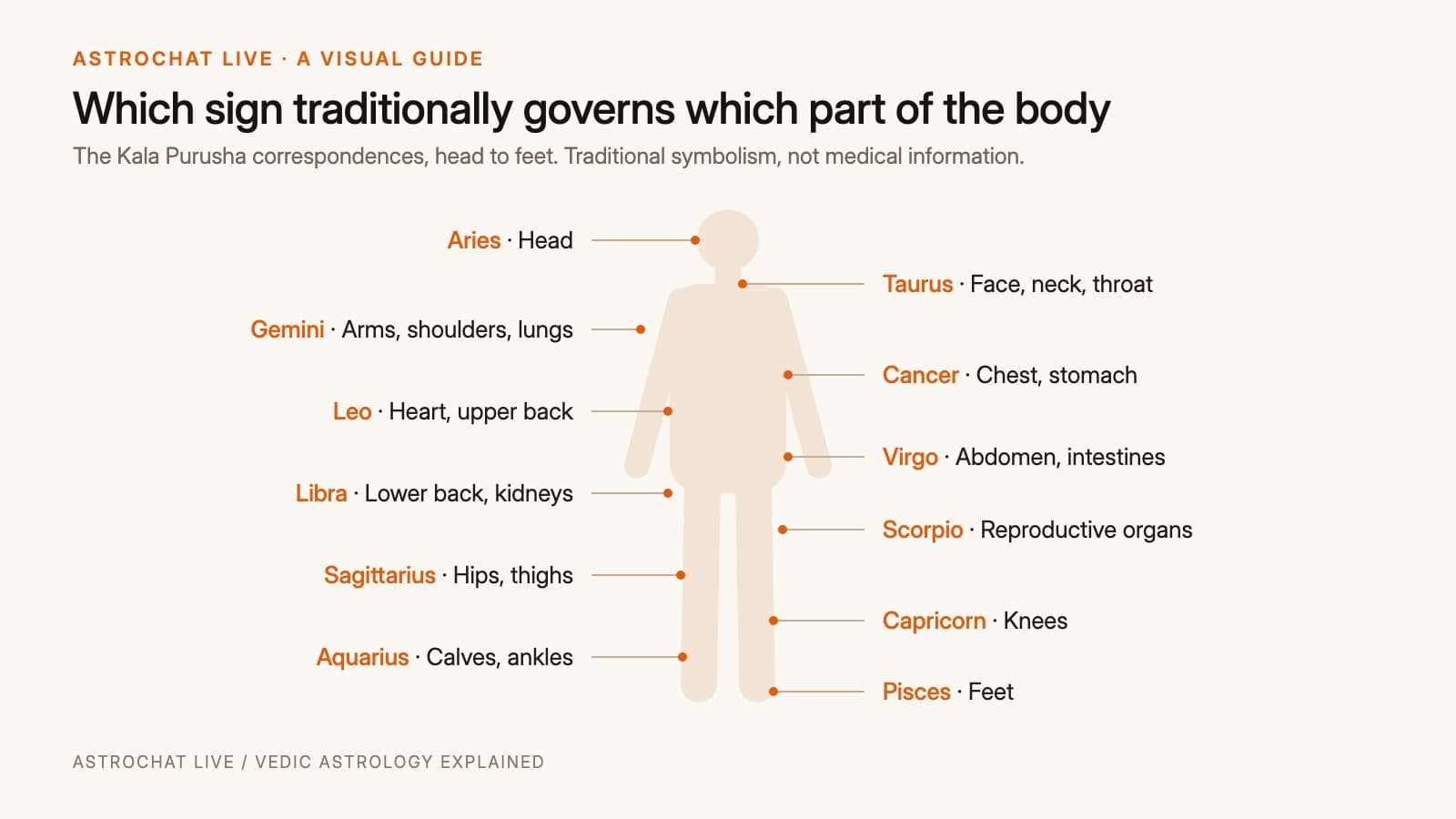
What the sixth house traditionally indicates
The sixth house covers illness, daily routine, service and the capacity to overcome obstacles, which is a broader remit than health alone. Interestingly, classical texts often read a strong sixth house as indicating resilience and recovery ability, not just susceptibility, so it is not the purely negative house it is sometimes described as being online.
Planets and the body parts associated with them
Each planet is traditionally connected to bodily systems: the Sun with vitality and bones, the Moon with fluids and the mind, Mars with blood and muscle, Mercury with the nervous system and skin, Jupiter with the liver, Venus with reproductive health, and Saturn with the skeletal structure and chronic patterns. These associations are traditional correspondences, nothing more.
How dasha periods factor in
Traditional practice holds that health related indications in a chart are more likely to surface during the dasha of the planets involved, which is why astrologers sometimes suggest extra care during particular periods. The responsible version of this advice is a prompt to get a routine check up, not a reason for anxiety about a specific illness.
Why astrology should never replace a doctor
It bears repeating clearly. No chart placement can diagnose a condition, and no remedy substitutes for treatment. The genuine, appropriate value here is that a reading might prompt someone to take a routine health check they had been putting off, which is a good outcome. Using a chart to self diagnose, or worse to avoid or delay treatment, is not.
FAQ
Reading about it is the easy half
Get answers from your own birth details on WhatsApp, or start with today's free rashifal for your sign.