Money and Wealth in Your Kundli: Understanding Dhan Yoga
Written by Bansi Joshi · AstroChat Live Astrology Team · Published 16 September 2026
Which houses actually govern money
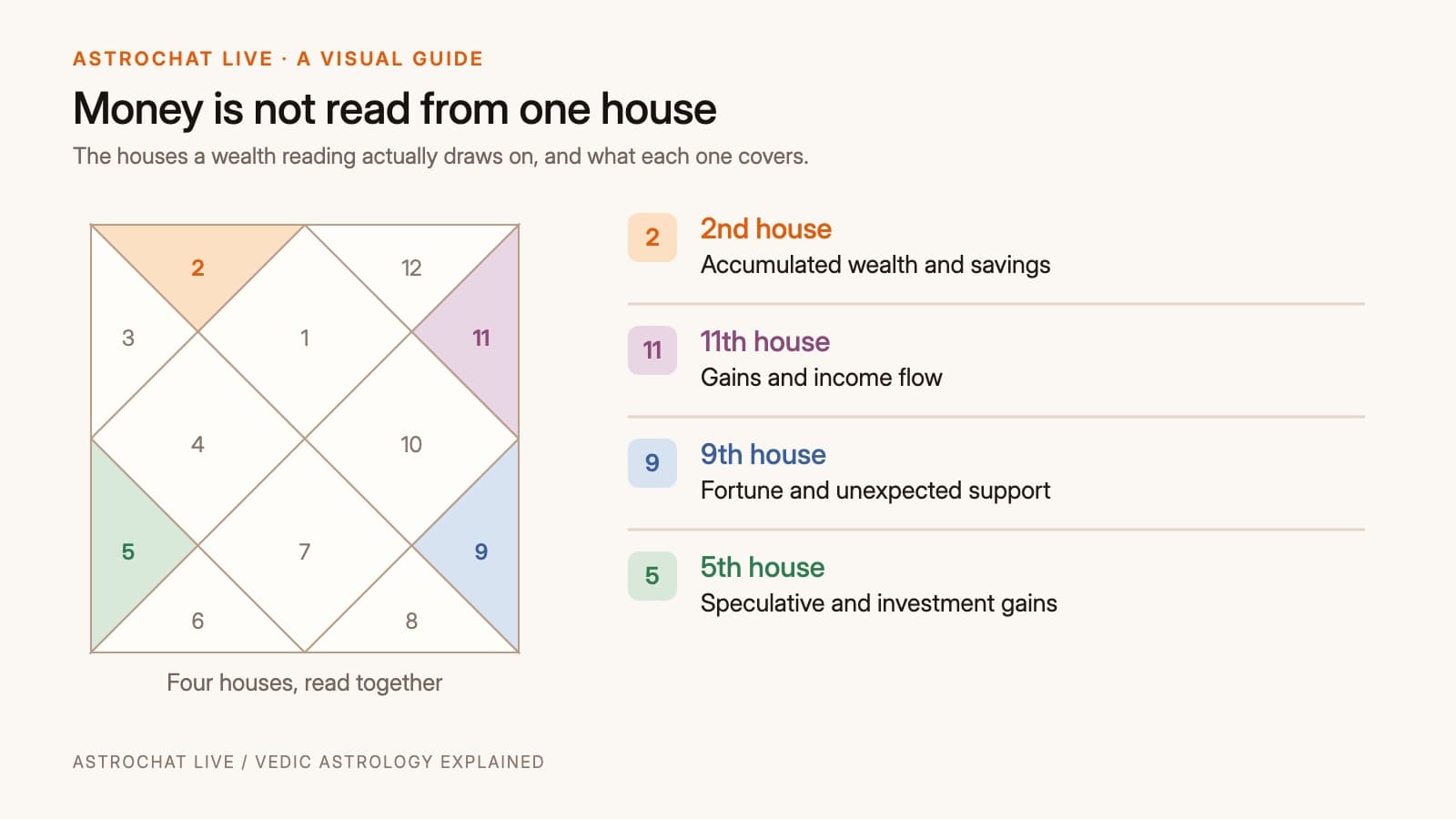
Money in a kundli is not read from a single house. The second house governs accumulated wealth and savings, the eleventh governs gains and income flow, the ninth governs fortune and unexpected support, and the fifth is often included for speculative or investment gains. A serious wealth reading looks at how these four relate to each other rather than checking any one of them alone.
What dhan yoga means
A dhan yoga is a specific planetary combination in a chart traditionally associated with wealth creation. It typically forms when the lords of the wealth related houses connect with each other, for example the second house lord placed in the eleventh house, or an exchange between the two. The term simply describes a structural connection between the parts of the chart that govern earning and keeping money.
The most cited wealth combinations
Among the most frequently referenced are Lakshmi yoga, formed when the ninth lord and Venus are both strongly placed, and the various raj yogas that combine an angular house lord with a trine house lord. It is worth knowing that yoga names circulate far more widely online than the actual conditions required to form them, and many charts described as having a particular yoga do not technically meet the classical criteria.
Why a wealth yoga still needs the right timing
This is the part most wealth astrology content leaves out. A chart can contain a genuinely strong dhan yoga that stays largely dormant until the dasha period of the planets forming it becomes active. Someone may spend two decades wondering why a promised wealth indicator never materialised, and then see it activate meaningfully when the relevant planetary period finally arrives.
Saturn, Jupiter and the two kinds of wealth
Jupiter is associated with expansive, sometimes fortunate gain, money that arrives through opportunity, guidance or growth. Saturn is associated with slow, structural wealth built through sustained effort over long periods. Charts weighted toward one or the other often describe very different financial lives, neither of which is better, though they demand quite different strategies from the person living them.
What a chart cannot tell you about money
A kundli indicates tendencies around earning capacity, timing and how money tends to arrive and leave. It does not specify amounts, and any reading that promises a precise figure or a guaranteed windfall is overstepping what the system actually does. It is also worth saying plainly that no chart replaces basic financial planning.
Using this reading practically
The most useful application of wealth astrology is timing rather than prediction. Knowing which periods of life your chart favours for expansion, and which ones favour consolidation and caution, is genuinely actionable. Treating it as a forecast of how rich you will become is not.
FAQ
Reading about it is the easy half
Get answers from your own birth details on WhatsApp, or start with today's free rashifal for your sign.