Amavasya and Purnima: Why the Moon's Phases Matter in Vedic Tradition
Written by Kunal Upadhyay · AstroChat Live Astrology Team · Published 16 September 2026
Why the moon carries so much weight in Vedic tradition
Vedic astrology is fundamentally lunar in a way western astrology is not. Your rashi is your moon sign, the calendar is lunar, the nakshatras track the moon's position, and the panchang is built around lunar days. Given all of that, it follows that the two extremes of the lunar cycle, the new moon and the full moon, carry more significance here than almost anywhere else.
What amavasya is and what it signifies
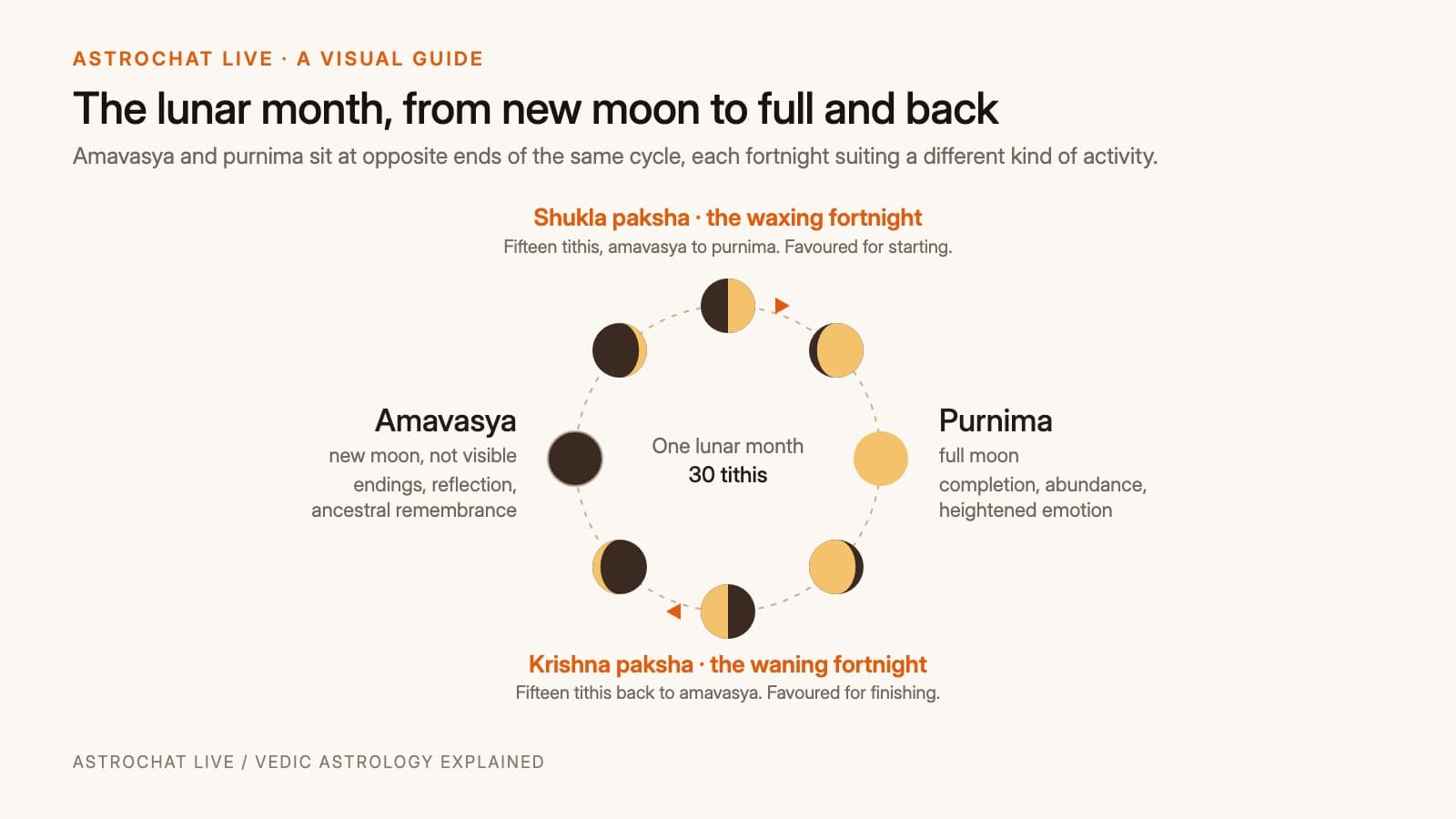
Amavasya is the new moon, the night the moon is not visible at all. Traditionally it is associated with endings, inward reflection and ancestral remembrance rather than new beginnings, which surprises people familiar with western new moon practice. Several important observances, including Mahalaya Amavasya and Diwali itself, fall on this tithi.
What purnima is and what it signifies
Purnima is the full moon, traditionally associated with completion, abundance and heightened emotion, since the moon governs the mind in Vedic thought. Many major festivals fall on purnima, including Guru Purnima, Buddha Purnima and Sharad Purnima, and it is broadly considered favourable for auspicious activity and charitable giving.
The tithis between the two
The lunar month is divided into two halves, shukla paksha, the waxing fortnight from amavasya to purnima, and krishna paksha, the waning fortnight back down. Each half contains fifteen tithis, lunar days. Shukla paksha is generally considered more favourable for starting new ventures, which is why muhurat calculations frequently favour it.
Practices traditionally associated with each
Amavasya practices centre on ancestral offerings, fasting and quiet reflection, and the day is traditionally not favoured for beginning new ventures. Purnima practices lean toward worship, charitable giving, fasting in some traditions, and completing or celebrating rather than initiating. Neither day is unlucky in any simple sense, they suit different kinds of activity.
How the lunar cycle interacts with your moon sign
When the moon transits through your own birth moon sign each month, a period sometimes called the moon return, traditional practice suggests emotions run closer to the surface. Similarly, the purnima falling in your birth nakshatra is considered personally significant. Tracking this for a few months is one of the easier ways to test whether lunar astrology matches your own experience.
Using the cycle practically
The genuinely useful takeaway is simple. Favour the waxing fortnight for launching and initiating, and the waning fortnight for finishing, clearing and consolidating. Even approached purely as a planning rhythm rather than a belief system, that structure gives most people a more deliberate monthly cadence than they had before.
FAQ
Reading about it is the easy half
Get answers from your own birth details on WhatsApp, or start with today's free rashifal for your sign.